
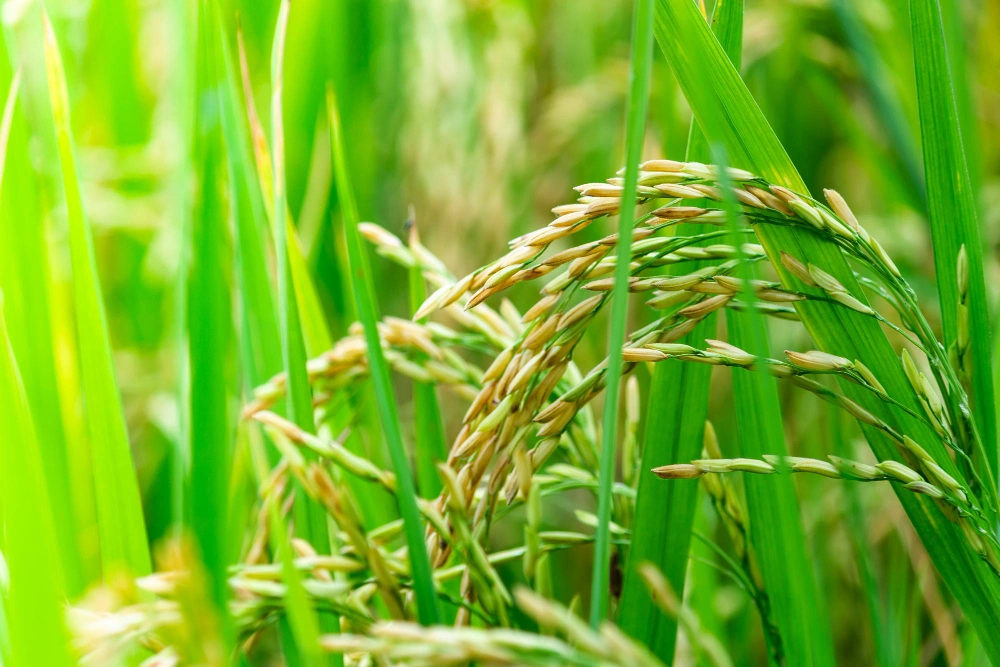
Rice (Paddy) is one of the most important food crops of India and plays a vital role in farmers’ income. Achieving higher yield and better grain quality depends on adopting the right package of practices from seed selection to harvesting.
In this blog, Surya Seeds brings you a step-by-step, farmer-friendly Paddy Package of Practices for sustainable and profitable rice cultivation.
Ideal Climate & Soil for Paddy Cultivation
- Climate: Warm and humid
- Ideal temperature: 20°C – 37.5°C
- Relative Humidity : 70-80% at flowering
- Rainfall: 100–200 cm (or assured irrigation)
- Soil type: Clay loam to loamy soil with good water-holding capacity
- Soil pH: 5.5 – 7.5
- Paddy grows best in levelled fields with standing water and fertile soil.
Seed Selection and Seed Rate
- Transplanted rice: 20–25 kg/acre
- Direct seeded rice (DSR): 30–35 kg/acre
Choose varieties based on:
- Local climate
- Crop duration
- Disease resistance
- Market demand
Nursery Management for Transplanted Paddy
- Nursery area required: 400–500 m² per acre
- Use raised or wet nursery beds
- Apply decomposed FYM or compost
- Seedlings ready in 20–30 days
- Maintain proper moisture and weed control
- Healthy nursery = strong main crop.
Land Preparation & Transplanting
- Plough field 2–3 times and puddle thoroughly
- Level the field for uniform water distribution
- Transplant 2–3 seedlings per hill
- Recommended spacing: 20 × 15 cm or 20 × 20 cm
- Proper spacing ensures better tillering and sunlight penetration.
Nutrient Management in Paddy
- Apply 4–5 tons FYM/acre before transplanting
- Use balanced fertilizers (NPK)
Split nitrogen application:
- Basal dose
- Tillering stage
- Panicle initiation stage
Balanced nutrition prevents lodging and improves grain filling.
Water Management
- Maintain 2–5 cm standing water
- Avoid continuous deep flooding
Drain water:
- Before fertilizer application
- 10–15 days before harvesting
- Proper water management saves water and improves root health.
Weed Management in Rice
First 30–40 days are critical
Control methods:
- Manual weeding (2 times)
- Mechanical cono weeder
- Recommended herbicides as per weed type
- Weed-free fields ensure higher nutrient availability to crop.
Pest & Disease Management
Common pests:
1. Stem borer
Spray per acre:
- 500 ml Methyl parathion 50 EC / Monocrotophos 36 SL, or
- 1 liter Chlorpyriphos 20 EC at 30, 50, or 70 days after transplanting
OR broadcast:
- 7.5 kg Cartap hydrochloride 4G or
- 0.3 kg Fipronil 0.3G mixed in 10 kg dry sand
2. Leaf folder
When 1–2 larvae per plant are observed:
- Spray 400 ml Quinalphos 20 EC or
- 200 ml Monocrotophos 36 SL in 200 liters water per acre
OR broadcast:
- 10 kg Methyl parathion 2% dust per acre
3. Brown planthopper
When 5–10 hoppers per hill are observed, spray per acre:
- 330 ml Buprofezin (Tricut 25 SC) or
- 250 ml Monocrotophos 36 SL or
- 125 ml Dichlorvos 76 EC or
- 400 g Carbaryl 50 WP in 200 liters water
OR broadcast:
- 10 kg Carbaryl 5% dust or
- Methyl parathion 2% dust per acre
Common diseases:
1. Blast
Spray per acre:
- 120 g Tricyclazole (Beam/Sivic) or
- 200 ml Carbendazim 50 WP or
- 200 ml Hinosan 50 EC in 200 liters water
- Second spray at 50% panicle emergence
2. Sheath blight
Spray per acre (twice):
- 400 ml Validamycin 3% L or
- 450 ml Hexaconazole 5% EC
First spray at disease initiation, second after 15 days
3. Bacterial leaf blight
- Use certified seed and treat the seed before sowing.
- Do not apply excessive nitrogen fertilizer and avoid very close transplanting.
- Apply fertilizers in a balanced and recommended dose.
- Do not allow standing water in the field; ensure proper drainage.
- Grow disease-resistant or tolerant varieties
- Follow Integrated Pest Management (IPM):
- Use resistant varieties
- Regular field monitoring
- Apply chemicals only when economic threshold level is crossed
Harvesting & Expected Yield
Harvest when 80–85% grains turn golden
Avoid over-maturity to prevent grain shattering
Average yield: 20–30 quintals per acre (varies with variety, soil & management)
✅ Conclusion: Key Practices for Higher Paddy Yield
- ✔ Use high-quality certified seeds
- ✔ Always treat seed before sowing
- ✔ Maintain balanced nutrition & water
- ✔ Timely weed, pest & disease control